A tiny house gets very small, very fast when the power drops. The right system keeps your lights on, your fridge cold, your water pump running, and your space feeling calm instead of fragile. If you are looking for the best battery backup for tiny house living, the answer is not one universal product. It is the setup that matches how you actually live, how often you move, and how much independence you want from the grid.
What the best battery backup for tiny house really means
Most people start by shopping battery capacity. That makes sense, but capacity alone does not tell you whether a system will feel effortless or annoying. In a tiny house, power is part of your daily rhythm. If your backup is too small, you start rationing basic comforts. If it is oversized, you may spend far more than you need and give up valuable space.
The best battery backup for tiny house use should do three things well. It should carry your essential loads without stress, recharge in a realistic amount of time, and fit the physical reality of compact living. That last part matters more than people expect. A technically impressive battery that is noisy, bulky, or awkward to install is not a great tiny house solution.
This is where a lot of buyers get stuck. They are not trying to build a survival bunker. They want a quiet, design-conscious system that supports normal life with less dependence on the grid. That is a different goal, and it changes what makes a battery backup worth buying.
Start with your actual power habits
Before comparing products, look at what your tiny house needs during a normal day and during an outage. Those are not always the same thing.
If your backup is only for short interruptions, you may only need to cover lights, internet, a fan, device charging, and refrigeration. If you want a more self-powered setup, your list probably expands to a water pump, vent fan, small kitchen appliances, and maybe a mini split or composting toilet fan.
The biggest mistake is assuming every appliance has to run exactly as usual. In a tiny house, good power planning is often about deciding what stays on all the time, what runs occasionally, and what should stay off during backup mode. A coffee maker or induction burner can draw a surprising amount of power in a short burst. A fridge draws less overall but needs dependable runtime. Those are different demands.
A practical way to think about it is this: define your essentials first, then your comfort loads, then your nice-to-haves. That gives you a battery system built around resilience, not guesswork.
Battery chemistry matters more than brand hype
For most tiny house owners, lithium iron phosphate, often called LiFePO4, is the clear front-runner. It lasts longer, handles deeper discharge, weighs less than older lead-acid systems, and needs less maintenance. In a small space, those advantages are hard to ignore.
Lead-acid batteries still have a place if budget is the main priority and you do not mind extra maintenance or reduced usable capacity. But in modern tiny house setups, they usually feel like a compromise. They are heavier, bulkier, and less forgiving. If your goal is a clean, dependable system you can live with for years, lithium is usually the better fit.
That said, not all lithium systems are equal. Build quality, battery management systems, temperature performance, inverter integration, and app control can all shape the ownership experience. A battery is not just a battery when your home depends on it.
Portable power station or fixed battery bank?
This is one of the biggest forks in the road.
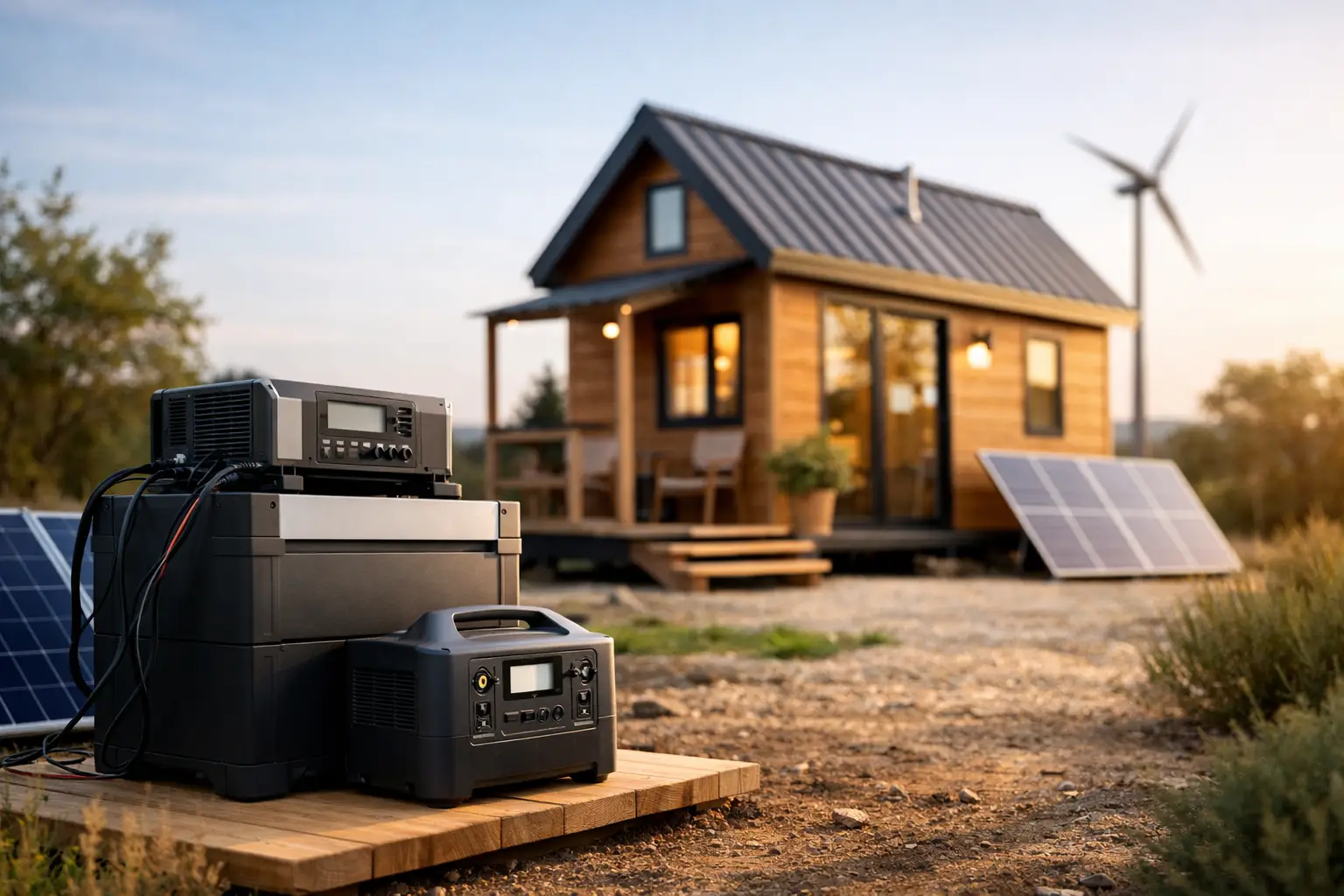
A portable power station is appealing because it is simple. You get the battery, inverter, charge controller, and outlets in one unit. For weekend tiny homes, short stays, or lighter energy use, this can be the smartest choice. It is also a strong option for people who want backup power now without committing to a full electrical redesign.
Portable systems tend to work best when your loads are modest and your lifestyle is flexible. If you mostly need power for lighting, charging, a fridge, Wi-Fi, and occasional small appliances, a premium power station can feel surprisingly complete.
A fixed battery bank makes more sense when your tiny house is full-time, solar-supported, or running higher-demand loads. This route gives you more capacity, more flexibility, and often a cleaner long-term installation. It also asks more from you up front. Sizing, wiring, inverter selection, ventilation, and code compliance all matter.
Neither route is automatically better. A portable unit offers convenience and lower complexity. A fixed system offers scale and integration. The best choice depends on whether you want backup power as an accessory or as part of your home infrastructure.
How much battery capacity is enough?
For many tiny houses, a battery capacity in the 2 to 5 kWh range is enough for essential backup. That can comfortably support lights, device charging, a router, ventilation, and refrigeration for a limited window, especially if you use power thoughtfully.
If you want your battery backup to carry more of your life without constant monitoring, 5 to 10 kWh is often the more comfortable zone. That range gives you more breathing room for water pumps, kitchen use, work-from-home needs, and cloudy-day resilience when paired with solar.
Beyond that, you are usually planning for a more independent energy system rather than simple backup. That can absolutely make sense, especially for full-time off-grid living, but the cost and installation needs rise quickly.
The right amount comes down to your tolerance for energy management. Some people are happy adjusting usage around weather and battery level. Others want the house to feel almost grid-normal. Be honest about which person you are.
Inverter size can make or break the experience
Battery capacity gets the attention, but inverter size determines what you can actually run. If the inverter cannot handle startup surges, your system may fail even when the battery is full.
Tiny house appliances often have short but demanding startup loads. Refrigerators, pumps, and air conditioning are common examples. A well-sized inverter should cover both your continuous wattage and those brief spikes.
This is also where cheap systems start to show their limits. On paper, two battery backups may look similar. In practice, one handles real-life use gracefully while the other trips, overheats, or forces you to baby every appliance. Quiet performance, stable output, and surge tolerance are worth paying for.
Charging speed and solar compatibility matter
A battery backup is only as useful as your ability to refill it. If you are relying on solar, pay close attention to solar input limits and charging efficiency. Some systems look great until you realize they recharge painfully slowly in average conditions.
For tiny house living, flexibility is valuable. Wall charging is helpful for grid-connected or hybrid setups. Solar charging is essential for more independent use. Vehicle charging can be useful for mobile builds or travel-based setups. The more recharge options you have, the more resilient the system feels.
This is one reason premium all-in-one systems have become so popular. They reduce friction. You are not piecing together six components and hoping they cooperate. You are buying something designed to support a simpler power routine.
Features worth paying for and features you can skip
In a compact home, convenience matters. App monitoring is genuinely useful because it lets you track battery level, charging rate, and load without opening compartments or checking multiple devices. Expandability is also valuable if you expect your energy needs to grow.
A good display, quiet operation, and reliable outlet selection all improve day-to-day life. These are not luxury details when your battery system is part of your home environment.
On the other hand, do not get distracted by flashy extras you will never use. If a feature sounds impressive but does not support your actual routine, it is just cost. The best system is the one that disappears into your life and does its job well.
Best battery backup for tiny house buyers by lifestyle
If you have a weekend tiny cabin or occasional retreat, a high-quality portable power station is often enough. It keeps the setup clean, low-commitment, and easy to transport or expand later.
If you live full-time in a tiny house with modest energy habits, a larger portable unit or a small fixed lithium system usually hits the sweet spot. You get enough comfort for daily living without overbuilding.
If your tiny house includes work-from-home gear, frequent kitchen use, water pumping, or climate control, a fixed battery bank paired with solar is usually the stronger long-term move. It costs more, but it supports a more stable lifestyle.
And if mobility matters, weight and charging flexibility move up the list fast. The best backup for a parked tiny home is not always the best choice for a rig that travels.
That is the real takeaway. Battery backup is not just a product category. It is part of how your home feels. The right system supports freedom quietly in the background, which is exactly how good off-grid living should work. If you want a setup that feels considered rather than improvised, choose for your real routine, leave room for growth, and let simplicity lead the decision.