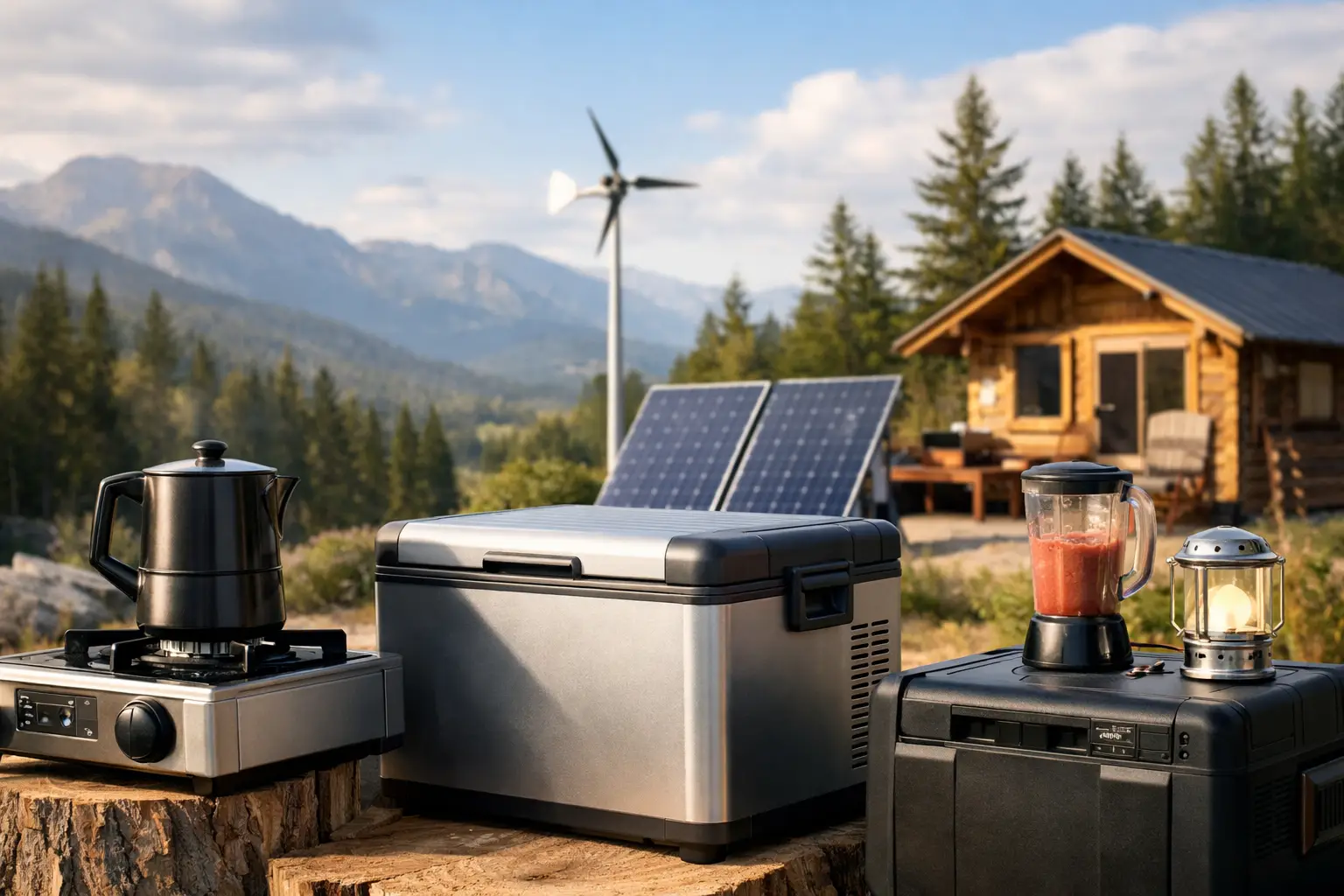
A quiet cabin morning does not have to mean cold coffee, dim rooms, or a lifestyle built around doing without. When people ask what appliances work off grid, the better question is: which appliances deliver real comfort without overwhelming your battery bank, solar array, or generator? The answer is more expansive than many first-time builders expect.
Modern off-grid living is not about rejecting useful technology. It is about choosing it with intention. The right setup can support a well-equipped tiny home, a polished weekend retreat, an RV, or a full-time cabin while keeping your energy use predictable and your independence intact.
What appliances work off grid?
Most household appliances can work off grid if the power system is designed for them. But some are far better matches for solar-supported living because they use less electricity, run for shorter periods, or can operate on propane instead of power-hungry electric heating elements.
Efficient lighting, refrigeration, water pumps, fans, electronics, laundry appliances, kitchen tools, and certain heating or cooking systems are all realistic options. The deciding factors are not simply whether an appliance is labeled “off-grid.” They are its wattage, how long it runs, whether it has a startup surge, and when you plan to use it.
A 1,500-watt appliance used for ten minutes can be manageable. A 300-watt appliance that runs all day may be a much bigger demand. This is why good off-grid design starts with daily energy habits, not a shopping list.
Start with the power system, not the appliance aisle
Before choosing appliances, get clear on your available energy. A basic system includes solar panels to collect power, batteries to store it, an inverter to run standard AC appliances, and often a backup generator for extended cloudy weather or unusual demand.
Battery capacity determines how much energy you can use after sunset. Solar production determines how quickly you can replenish it. Your inverter rating determines which appliances can run at one time. A compact retreat with lights, a small refrigerator, charging stations, and a water pump has very different needs than a home with electric heat, central air conditioning, and an induction range.
Look at both watts and watt-hours. Watts measure the appliance’s draw at a given moment. Watt-hours show the total energy it uses over time. For example, a 60-watt fan running for eight hours uses roughly 480 watt-hours. That is usually easy to plan for. A 1,500-watt space heater running for eight hours uses 12,000 watt-hours, which can drain a modest battery bank quickly.
Also account for startup surge. Refrigerators, well pumps, power tools, and compressors can briefly require several times their normal running wattage when they start. Your inverter must be able to handle that momentary demand.
The best off-grid kitchen appliances
The kitchen is where intentional choices pay off fastest. Refrigeration is usually a daily essential, and modern Energy Star refrigerators can be a practical fit when properly sized. A smaller, efficient fridge often makes more sense than a large residential model with an ice maker, even if you have room for it. Chest freezers can also be surprisingly efficient because cold air stays inside when the lid opens.
For cooking, propane remains an excellent off-grid option. A propane range or cooktop removes one of the largest electrical loads from your battery system and performs reliably in every season. It is a strong choice for cabins and tiny homes where energy independence matters more than having an all-electric kitchen.
Induction cooktops can work well too, particularly in solar-rich locations with a capable inverter and battery bank. They are efficient, fast, clean-lined, and appealing for design-forward small spaces. The trade-off is their high instant power draw. Many owners use a portable induction burner during sunny midday hours, then rely on propane or outdoor cooking when batteries need to stretch.
Small appliances deserve the same scrutiny. Electric kettles, toaster ovens, air fryers, blenders, coffee makers, and microwaves are not automatically off limits. They simply work best as short-use appliances that fit your inverter capacity. A French press or manual grinder may feel more aligned with a slow cabin morning, but there is no rule against a well-timed espresso machine if your system can support it.
Comfort appliances that make a retreat feel like home
LED lighting is one of the easiest wins in off-grid living. It uses very little power, gives you flexible warm or task-focused lighting, and helps a compact home feel composed after dark. Pair it with thoughtful fixtures rather than treating lighting as an afterthought.
Ceiling fans and efficient DC fans are also excellent choices. Moving air uses far less energy than air conditioning and makes warm spaces more comfortable in summer. In colder months, a fan can circulate warmth from a wood stove or propane heater.
Heating is where the fuel choice matters most. Electric space heaters are simple but demanding, and they can consume more energy than a small solar setup can comfortably provide. Propane heaters, wood stoves, pellet stoves, and properly installed diesel heaters are often more realistic primary heat sources. Each comes with ventilation, safety, maintenance, and fuel-storage considerations, so choose based on the home, climate, and how often you will be there.
Air conditioning is possible off grid, but it requires honest planning. A high-efficiency mini-split can be a smart solution for a well-insulated tiny home with a larger solar and battery system. For a seasonal cabin, shade, reflective window coverings, ventilation, insulation, and fans may offer a more efficient path to comfort. The goal is not to prove you can power every appliance. It is to build a space that stays comfortable without constant energy anxiety.
Water, laundry, and cleaning appliances
A pressure pump is central to a functional off-grid water system. Many 12-volt pumps are efficient and work directly from battery power, while AC well pumps may require a larger inverter and substantial startup capacity. If you use a well, pump specifications should influence your system design early.
Tankless propane water heaters are a popular choice because they provide hot water without maintaining an electrically heated tank all day. Electric water heaters can work, especially when programmed to heat during peak solar production, but they are typically a major load. Heat-pump water heaters are more efficient than conventional electric tanks, though their fit depends on climate, space, and system size.
Laundry is possible, with a few compromises. Compact front-load washers use less water and generally less energy than traditional top-load models. Cold-water cycles reduce demand further. A vented electric dryer is one of the harder appliances to justify on a modest system, while a propane dryer, ventless heat-pump dryer, clothesline, or drying rack can make more sense. For a weekend property, a beautiful drying rack near a sunny window may be more useful than an oversized laundry room.
Vacuum cleaners, cordless tools, and small cleaning appliances are usually manageable when used briefly. Recharge them during the day, avoid running several high-draw appliances together, and keep a close eye on the energy budget after a stretch of poor weather.
Appliances to approach with caution
Some appliances are technically possible but can reshape the cost and complexity of the entire system. These include electric resistance heat, large conventional water heaters, full-size electric dryers, electric ovens used daily, hot tubs, pool pumps, and older air conditioners.
That does not mean these choices are wrong. A larger year-round home in Arizona with abundant sun may support a mini-split system and induction cooking comfortably. A shaded forest cabin in the Pacific Northwest may benefit more from propane, wood heat, and lower-draw essentials. Location, insulation, seasonal use, and desired level of comfort all change the equation.
The clearest rule is simple: avoid designing around peak demand you only need occasionally. It is often more affordable to use a propane appliance, schedule a task for sunny hours, or keep a backup option than to buy enough batteries and inverter capacity for every possible scenario.
Build an appliance plan around your real life
Make a list of the appliances you use daily, weekly, and rarely. Then separate essentials from conveniences. A refrigerator, lights, water pump, phone charging, and ventilation may be nonnegotiable. A countertop ice maker or electric blanket may be a welcome luxury, but it should not dictate the entire system.
From there, calculate estimated daily watt-hours and consider when each appliance will run. Solar-powered living rewards timing. Run laundry, power tools, vacuuming, and high-draw kitchen appliances while panels are producing strongly. Reserve stored battery energy for nighttime lighting, refrigeration, water, and the calmer parts of your routine.
Off The Grid Store approaches this lifestyle as a design decision as much as an energy decision. The most satisfying spaces are not packed with compromises. They are built around a few dependable, efficient essentials that support how you actually want to live.
Choose appliances that make your place more livable, not more dependent. A well-made meal, hot shower, charged lantern, and quiet room can be more than enough proof that independence still has room for comfort.