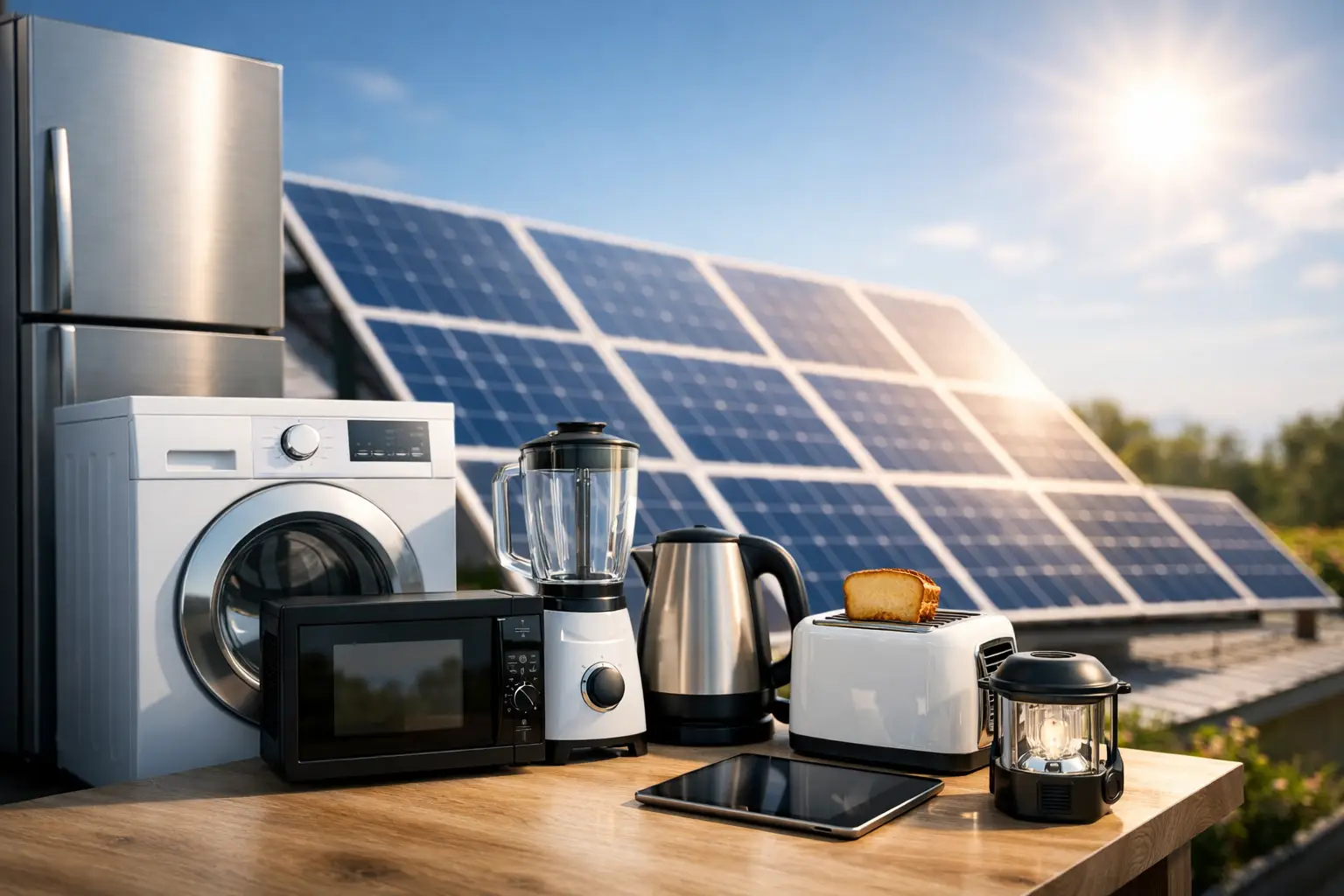
A quiet cabin morning can feel completely self-sufficient until the coffee maker trips the inverter. Learning how to choose solar ready appliances starts with that practical truth: the best appliance is not simply labeled “solar ready.” It fits the way you live, the size of your solar system, and the level of comfort you want when the grid is nowhere nearby.
For a tiny home, weekend retreat, camper, or full-time off-grid setup, every watt has a job. Choosing well lets you keep the comforts that make your space feel like home without building an oversized, expensive power system around one demanding appliance.
What “Solar Ready” Actually Means
“Solar ready” is useful shorthand, but it is not a standardized appliance category. A product may use the phrase because it is energy efficient, because it can run on a battery-backed inverter, or because it accepts low-voltage DC power directly. Those are very different things.
Most households use conventional AC appliances powered by an inverter. This is often the simplest route because it gives you more choice in finish, capacity, and performance. A solar-ready AC appliance should have low everyday energy use, reasonable startup demand, and a power draw your inverter and battery bank can support.
Some appliances run on 12V, 24V, or 48V DC. These can be excellent for small cabins, vans, and compact systems because they avoid some inverter losses. The trade-off is a narrower product selection, specialized wiring, and less flexibility if you later change system voltage. DC is not automatically better. It needs to match the system you are building.
The label matters less than the numbers. Look for rated watts, daily energy consumption, voltage, startup or surge power, and operating temperature range. If a manufacturer does not make those details easy to find, treat that as a reason to pause.
Start With Your Real Life, Not a Product Wishlist
Your appliance plan should begin with the rhythms of your space. A weekend cabin occupied by two people has different demands than a family tiny home or a remote work retreat where laptops, lights, refrigeration, and internet equipment run every day.
Think in routines. What must work after a cloudy afternoon? What can wait for bright midday solar production? A refrigerator is a constant load. A blender may run for two minutes. A washing machine, induction cooktop, space heater, and electric kettle can each draw significant power, even when their total run time is short.
This distinction helps you protect the feeling you are after. Off-grid living does not require giving up comfort. It asks you to choose comfort with intention. A smaller, efficient refrigerator and a propane or wood-fired heating plan may create a calmer, more resilient setup than trying to power full-size electric heating from a modest battery bank.
Separate essential loads from flexible loads
Start with essentials: refrigeration, water pumping, lighting, basic cooking, ventilation, communications, and medical equipment where applicable. These are the appliances and systems that need dependable power through poor weather.
Then identify flexible loads. Laundry, vacuuming, countertop cooking, power tools, and water heating can often happen when batteries are full and solar production is strong. This does not mean living by a strict schedule. It means designing a system that gives you options instead of surprises.
Size Appliances by Watt-Hours, Not Just Watts
Watts tell you how much power an appliance uses at a particular moment. Watt-hours tell you how much energy it uses over time. For solar planning, both matter.
Use this simple calculation:
Watts × hours used per day = watt-hours per day
A 60-watt fan running for eight hours uses about 480 watt-hours per day. A 1,500-watt kettle used for four minutes uses roughly 100 watt-hours. The kettle has a much larger instant draw, but the fan may consume more energy across the day.
Add the estimated daily watt-hours for every appliance you expect to use. Then include room for inverter losses, battery charging losses, seasonal changes, and the inevitable device you forgot to count. A 20 to 30 percent planning margin is often sensible, though a remote, year-round home may need more depending on local weather and backup options.
Startup power deserves separate attention. Compressor-based refrigerators, freezers, pumps, and air conditioners can require a brief surge above their normal running wattage. Your inverter must handle that surge, even if your daily energy total looks modest. Check the appliance documentation and compare it with both the inverter’s continuous rating and surge rating.
Prioritize Efficiency Where It Has the Biggest Impact
Not every appliance deserves the same level of scrutiny. Focus first on loads that run for hours or operate every day. A refrigerator, freezer, water pump, ventilation fan, and internet setup have a greater effect on your energy budget than a toaster used occasionally.
For refrigeration, look beyond the exterior size. Check annual kilowatt-hour use, usable interior capacity, compressor type, and the temperature conditions where it will operate. A highly efficient unit can save enough daily energy to reduce pressure on your batteries, especially in summer heat or during a stretch of cloudy weather.
For cooking, high-wattage electric appliances are not always a bad choice. Induction can be fast, clean, and efficient at the pan, making it appealing for a well-sized solar system. But it can place a heavy demand on the inverter and battery bank. A compact induction burner used during sunny hours may be a better fit than a large electric range used at night.
Heating is where many first-time off-grid plans become unrealistic. Resistance heaters, electric water heaters, and clothes dryers consume a great deal of energy. In most small-scale solar setups, propane, wood, solar thermal, heat-pump technology, or air drying will be more practical. The right answer depends on your climate, insulation, occupancy, and willingness to use a backup fuel source.
Match Voltage and Electrical Design Before You Buy
A 12V appliance can be a smart choice for a small mobile setup. For a larger cabin or tiny home, 24V or 48V battery systems often move power more efficiently and can support bigger loads with less current. That does not mean every appliance needs to match battery voltage directly. It means the electrical design should be decided before purchases begin.
If you are using AC appliances, confirm that your inverter provides the correct voltage and frequency for US products: typically 120V and 60 Hz. For larger equipment, verify whether it requires 240V split-phase service. A standard portable inverter may run lights and a refrigerator beautifully but will not necessarily support a well pump, range, or mini-split designed for 240V.
Also consider appliance controls. Some modern appliances have electronic boards, Wi-Fi features, and sensitive startup behavior that may not play well with a low-quality modified sine wave inverter. A pure sine wave inverter is generally the better choice for reliable appliance operation and quieter performance.
Choose Durability and Repairability Over Extra Features
Off-grid appliances work in places where service calls can be inconvenient and expensive. A good product should be efficient, but it should also be built for the conditions around it: dust, temperature swings, limited ventilation, travel, or occasional periods of nonuse.
Simple controls can be an advantage. A refrigerator with a clear thermostat and accessible replacement parts may serve a cabin better than a feature-heavy model that depends on an app connection. For water pumps, look for proven components, easy winterization, and available repair kits. For laundry, a compact washer with lower water use may be more valuable than a large machine with a long list of cycles.
This is also where sizing down can improve the experience. A smaller appliance is often easier to power, transport, maintain, and integrate into a thoughtful small-space layout. Freedom is not measured by how much equipment you can fit into a system. It is measured by how confidently the system supports your life.
Read Energy Labels With a Critical Eye
Energy labels are a useful starting point, especially for refrigerators, dishwashers, and laundry equipment. Still, they reflect standardized test conditions, not every real-world scenario. A refrigerator in a hot, unconditioned shed will use more energy than the same unit in a climate-controlled kitchen.
Compare models using annual energy consumption, but also look for actual user manuals. Manuals often reveal running watts, circuit requirements, clearance needs, and temperature limits that marketing pages leave out. If you are deciding between two similar appliances, the one with clearer specifications is usually the safer choice for a self-powered setup.
Build in a Little Future Flexibility
Your first solar setup does not need to power every possible appliance on day one. It should support the life you plan to live now while leaving a sensible path for growth. Choose an inverter, charge controller, battery configuration, and electrical panel that can expand if you expect to add solar panels, a freezer, or a workshop load later.
Avoid buying an appliance solely because it might suit a future system. Buy for the system and lifestyle you have planned, then leave space to evolve. A well-chosen solar-ready appliance should make your retreat feel easier to use, not turn every cloudy day into a calculation.
The strongest off-grid spaces are not the ones packed with the most technology. They are the ones where every appliance earns its place, energy feels abundant enough, and you can step away from the noise knowing your home still has what it needs.
Leave a Reply